

Canvas Flow Redesign
UX Research | B2B SAAS | MarTech
Overview
-
Used innovative methodology to bring momentum and clarity to projects to improve UX in Braze's Canvas feature previously blocked by stakeholder-reprioritization.
-
Presented the findings to executive product leadership and defined a place for these projects on upcoming team roadmaps.
My Role
Principal UX Researcher, Project Manager, Interviewer, Analyst
Team:
1 Product Manager, 2 Product Designers, 1 UX Researcher (me)
Timeline
Q2 - Q3 2025
Methods:
Moderated qualitative interviews, Comparative analysis, Budget allocation, Hands-on feature exploration, Dogfooding research
Problem
UX improvements kept getting deprioritized despite years of validated research
Approach
Reframed the goal around sellability; designed a novel 3-method research session with Solcons
Outcome
Feature dependencies surfaced, roadmap sequencing defined, exec alignment achieved
Problem
Braze is a customer engagement platform used by marketing and lifecycle teams at enterprise companies. Canvas Flow is Braze’s visual no-code customer journey building tool that allows marketers to orchestrate multi-channel messaging campaigns. It serves as the platform’s flagship central editing experience. See more info here.
Canvas users had consistently highlighted well-documented pain points related to inefficiency and clutter. And while our research and product team had implemented usability improvements in the past, many of our researched and validated quality of life features were repeatedly backlogged in favor of unlocking new use cases and catering to Braze's most sophisticated, high-value customers, leaving structural, long-standing user frustrations untouched.


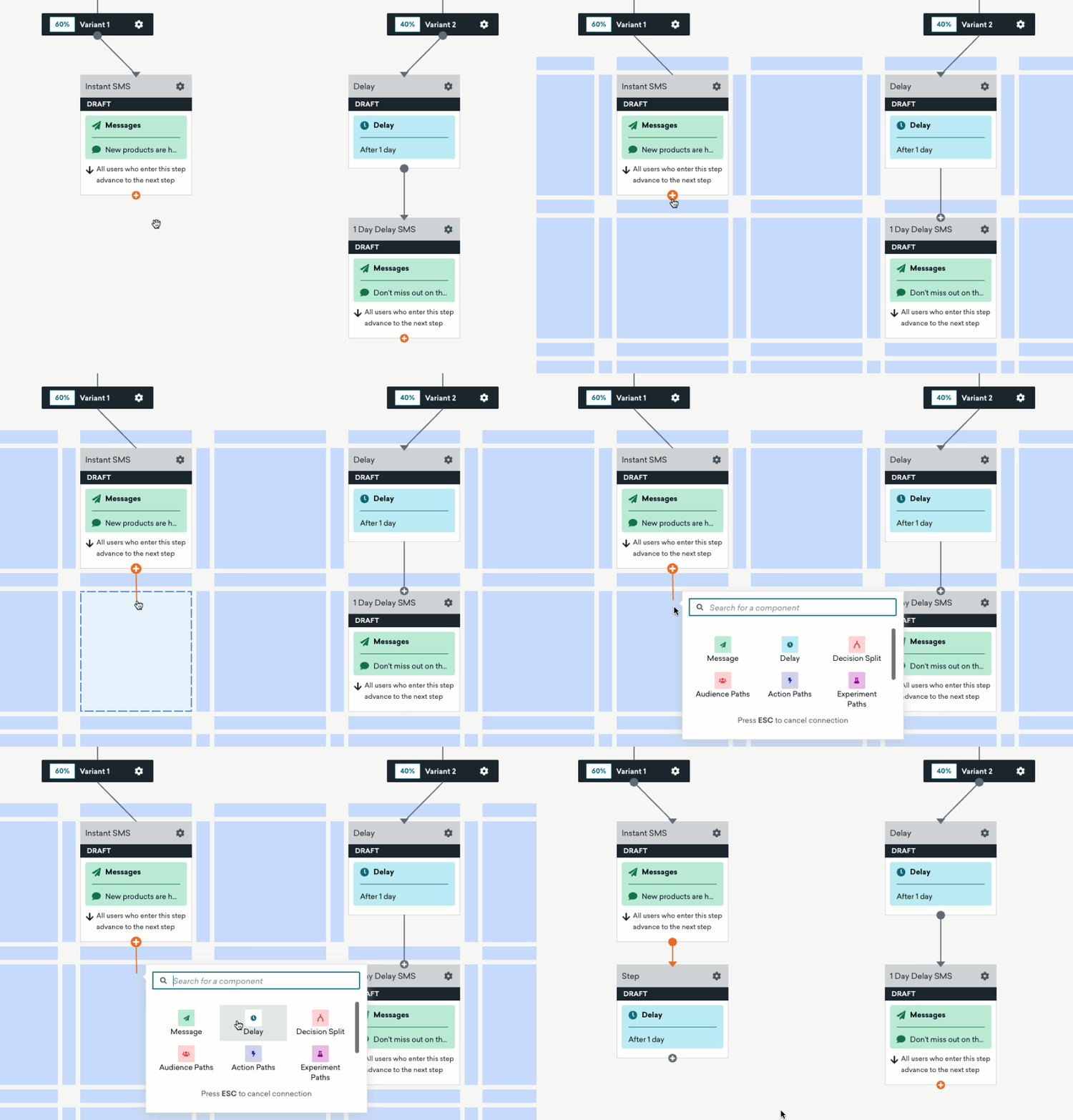

Images sourced from braze.com
What we knew - and why it wasn't enough:
-
We had plenty of evidence to prove what users needed.
-
From annual roadmap planning research to influence feature prioritization, we had evidence of highly ranked UX improvements & solutions to well-known usability pain points.
-
From exhaustive generative and concept research on such solutions one by one, we knew why users ranked these features highly with context about their underlying frustrations
-
Support tickets and survey responses year after year provided supporting insights from the larger customer population, calling out the same popular frustrations.
-
-
The evidence wasn't moving the needle.
-
There was a persistent gap between what users needed and what exec thought should get prioritized. We were working with an unconvinced audience, so doing more research of the same kind wasn't going to close the gap.
-
-
The gap between Braze execs and user needs was not the only audience gap that needed to be addressed. The people using Braze are not the people in charge of buying it.
-
C-suite executives who decide whether to buy Braze prioritize innovation and revenue, often overlooking day-to-day usability issues that don't significantly impact churn or product roadmaps. While CRM marketers face frequent frustrations, C-suite executives tend to favor features that drive growth, creating a gap between user needs and executive priorities.
-
Reframing the research goal:
Since advocating for user-favored features wasn't working, we reframed the research goal entirely. Our goal was no longer just to satisfy user needs with product solutions, but to prove a business case for the product solutions beyond "UX improvement".
Could we demonstrate that usability improvements can in fact influence sell-ability? And how could we make these usability improvements more eye-catching to buyers?
Hypothesis:
Instead of continuing to advocate for improvements one at a time, we could package the features into a marketable “new canvas experience” that essentially combines UX improvements into one, cohesive release.
If packaged effectively, these quality of life features could deliver significant value not only to our existing customers but also to prospects during sales cycles.
Features tested included:
-
Bulk actions
-
Autosave
-
Multi-user editing
-
Free-form creation space (not tied to a restrictive grid system)
We already knew each feature addressed a real need. What we didn't know was how they interacted — whether adding one would reduce the need for another, create a dependency, or change the workflow entirely. The research question wasn't should we build these? It was which combination, in what order, makes for the strongest product and the strongest case?
Research goals:
-
Identify valuable feature combinations that enhance user experience
-
Discover a cohesive canvas experience where the value from integrating these features exceeds the sum of their parts
Strategic goals:
-
Establish a place on the roadmap for these features that wouldn't risk getting deprioritized in the future.
-
Demonstrate that usability improvements do in fact influence sellability of Braze to convince stakeholders to prioritize these user needs
Research Approach
Participants:
6 Braze Solutions Consultants (Solcons)
We specifically chose to interview SolCons because:
-
They are internal Canvas experts who could pilot a novel methodology before we took it to customers.
-
They see Canvas through the lens of prospects and new users, which may differ from existing users and relate to the "sellability" angle
-
They can tell us what Canvas problems they actively hide during sales demos and what they see as solutions to those problems
Methods:
Our previous methods included qualitative interviews, ranking activities, and money allocation. But talking about the features individually with users would not give us any new info. We already knew the degree of user needs and frustrations. Those methods would not suffice.
Research Design Challenge:
-
How might we test the combined value and interactions of features for an entirely new canvas system?
-
How might we let users interact with a newly imagined canvas space without building an entirely new canvas space?
Through creative imagination, brainstorming as a group, and doing async research about market research methods, I came up with a menu of research methods that would help us identify the optimal combination of features.
Interview setup:
60 min Google Meet interview with Braze Solcons
-
Build a canvas in Figjam
-
Budget Allocation
-
Round 1: No constraints
-
Round 2: Constrained
-
-
Feature Ranking (Conjoint Analysis)
-
Round 1: Groups of 2s
-
Round 2: Groups of 3s
-
Attendees:
-
SolCon (interviewee)
-
Myself - UXR (interviewer)
-
Product Manager (note-taker + follow-up questions)
-
Optional: Product designer (context, follow-up questions)
Build a Canvas in Figjam
Task:
We created a custom FigJam template using screenshots of Canvas menus and step types, giving participants a rough canvas-building experience without requiring a fully built prototype.
-
Ask users to build a typical Canvas in Figma’s Figjam interface
-
Probe about how this is different from their usual Braze Canvas experience
Goals:
-
Expose users to new functionality (autosave, no-grid, bulk actions, multi-user editing) without exposing the purpose of the activity or calling out the features
-
Allow users to naturally experience how these features might affect their Canvas workflow before asking about their preferences
** We kept our prompts broad and non-leading. If participants went off-script (ex: commenting on things unrelated to the four features), we let them, because we didn't want them to feel like they were getting something wrong and filter their feedback throughout the session.

*Image from Figma.com, no longer have access to Canvas template
Why Figjam?
We were concerned that building a new interactive environment would be an extreme design effort that could limit user imagination and encourage them to critique the prototype too narrowly, rather than focusing broadly on the building process and their needs..
Figjam already has the features we wanted to evaluate: multi-user editing (live cursors), autosave, bulk actions (multi-select and drag), and a free-form no-grid canvas. Participants could encounter all four features organically, in combination, without us calling them out directly.



Insights
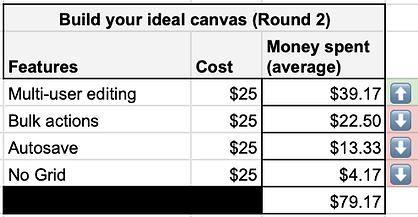
Following conjoint analysis instructions, I averaged and ranked features across all activities, both individually and in combination. This let us validate the findings against our previous individual-feature research and confirm the methodology was producing consistent signal.
Qualitative Insights:


Multi-user editing was consistently top-rated
-
This mirrors its top-rank in feature ranking activities from our team's previous roadmap research. This revealed a pressing need for ways to make collaboration in Canvas easier.
"I believe [multi-user editing] would be definitely helpful for all the bigger teams that we work with. For all the bigger teams that are working with multiple people on more complex canvases, this could be quite a big improvement"
Multi-user editing + Autosave were seen as inseparable
-
The pair was ranked as the most important feature duo, but they have critical dependencies on each other to be mutually beneficial. One without the other creates real usability problems and they need to exist in Canvas together.
“Manual saving would be incompatible with real-time collaboration. Every other platform I could think of that has multi-user editing it feels like it has the continuous autosave going on"
Bulk actions ranked second overall due to individual favoritism
-
Participants thought it had high individual value, with little dependencies on other features. It can be prioritized independently.
"I think bulk actions are going to be the most transformational thing in terms of time saving for people who are executing"
"No-grid" or free-form creation was consistently bottom-rated
-
Participants were clear that it did not address a real pain point for them or their prospects. This also is supported by previous roadmap research findings.
“No grid I don't think helps us tremendously. I've never had a customer or a prospect gripe about our inability to have a flexible grid system"
Outcomes
I presented findings jointly with the PM to executive product leadership and the broader department during a product all-hands meeting. Co-presenting with product management was a deliberate choice because it signaled team alignment and collective intent to act on the insights, rather than research sitting in isolation promoting uncertainty of the team's agreement to UXR's recommendations.
Concrete outcomes:
Outcome 1: Feature dependencies surfaced for the first time
When we carried out individual research on these features and did feature ranking exercises, we only had user rankings to establish roadmap priority amongst features. Results from this study told us that multi-user editing and autosave cannot ship independently without creating new usability issues.
Outcome 2: Clear roadmap path with sequencing requirements
Knowing feature dependencies such as those affecting autosave and multi-user editing changed our prioritization calculations: these features would need to be ironed out before any other features could be shipped, and they would need to be shipped together for a successful release.
Outcome 3: Clear deprioritizations for the future of Canvas
We effectively and immediately deprioritized “no-grid” feature exploration which had previously retained a place on the roadmap despite low user desire and high engineering effort. This not only validated existing user low-sentiment, but disproved the hypothesis that users want a more "Figma-like" experience, with more freedom of movement in the Canvas, since other features existing in co-creation platforms (bulk actions, autosave, multi-user editing) were regarded so highly. Through this research we were able to decide that "no-grid" had no hold on making the other features successful, and that users could enjoy other co-creation features with a more rigid grid structure that Canvas offers.
Outcome 4: Validation and reinforcement of prior research findings
Sentiment for the individual features was consistent with previous research findings, which not only validated the user needs with repeated results but proved that the experimental methodology was credible as it produced consistent signal with previous qualitative research.
Why this worked when previous research hadn't:
Prior studies asked users to rank features individually. That approach gave us good signal on each feature's standalone value — but it couldn't tell us about dependencies, conflicts, or which combinations would create a meaningfully better product. This study did.
By putting features in conversation with each other (literally and methodologically), we uncovered sequencing requirements that changed the prioritization calculus entirely. It's not just about which feature users want most — it's about which features need to exist together to be released successfully.
Recruiting Solcons was also a key factor: it gave us access to the prospect perspective without the friction of customer recruitment, and produced candid insights about what's being actively hidden in sales demos — something we couldn't have learned any other way.
“Exceeding the expectation to simply execute standard methods, Anna introduced advanced quantitative techniques—specifically Conjoint Analysis and budget allocation simulations—to the Canvas Redesign project. When standard interviews failed to provide clear direction, she used these methods to provide the team with a data-driven hierarchy of user needs. This approach directly influenced the roadmap by validating the need to deprioritize the 'no-grid' feature, saving engineering cycles on low-value work.”
- Ki Choi, Director of UXR
Feature dependencies surfaced for the first time
Clear roadmap path with sequencing requirements
Clear deprioritizations for the future of Canvas
Validation and reinforcement of prior research findings
Takeaways
-
When research results are not the problem, reframe the goal.
Years of validated research hadn't moved the roadmap. Rather than running another prioritization study, I recognized the real gap was strategic — we needed to make the business case, not just the user case. Reframing the research goal around sellability, not just usability, was what finally gave the team a path forward.
2. Methodological creativity is a research skill.
No existing method let users experience four features interacting together without building a prototype. I designed a session from scratch — combining FigJam dogfooding, budget allocation, and conjoint analysis — to get there. When the right method doesn't exist, I build it.
3. The right participant isn't always the obvious one.
Recruiting solutions consultants instead of customers wasn't a compromise — it was a better answer. They gave us the prospect lens we needed, surfaced what gets hidden in sales demos, and got us to insights faster. I look for participant pools that carry the perspective I need, even when they're not the default choice. I ended my employment with Braze before we got the chance, but the next step for this study was to conduct a follow-up study with customers to validate the Solcon findings.
4. Research influence requires more than good findings.
Co-presenting with the PM wasn't incidental. It was a deliberate choice to show exec leadership that the product team was aligned and ready to act. Getting research onto the roadmap means thinking about the room you're presenting to, not just the deck you're presenting.
